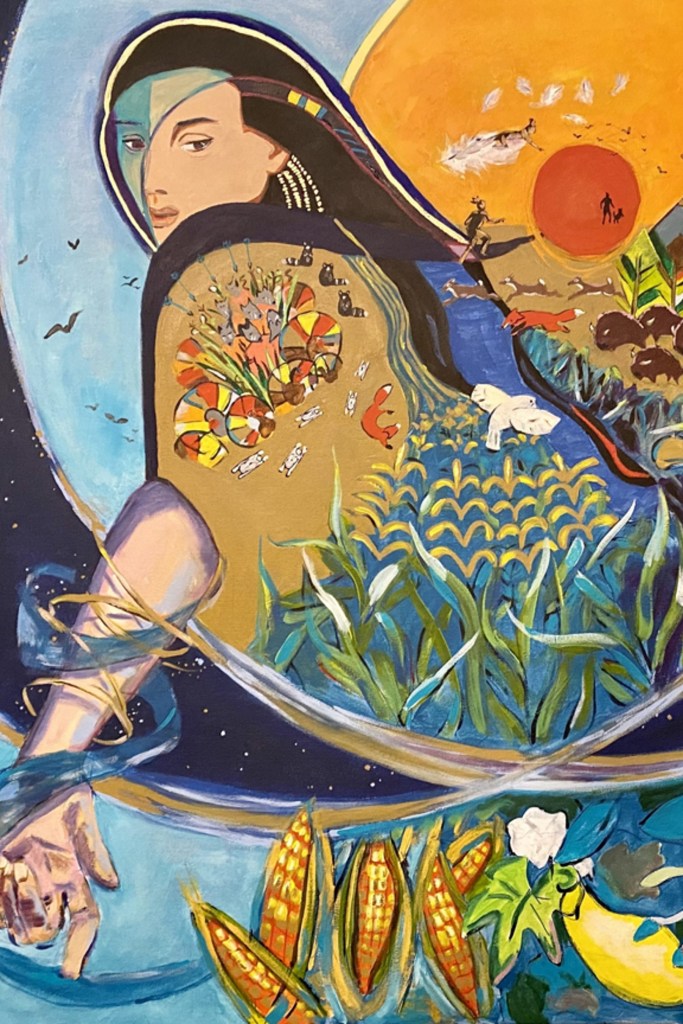
In 2022, I painted what I believed might be the best painting I had ever created.
The subject came from one of our traditional Cherokee stories—Selu and Kanati. I had poured myself into it. When I finished, I entered it in a Cherokee art competition.
It was juried out.
That surprised me. My work had always been accepted before, including a realism piece. So, because I was genuinely shocked, I asked why.
The explanation I received was that, ultimately, the painting subjectively read as “Plains” style and had been juried out for that reason. The coordinator went on to explain that the juror was looking for more traditional Cherokee motifs and symbolism.
I understood the explanation. I still do. But something about that experience stayed with me.
The story was Cherokee. The artist was Cherokee. But apparently, the way I chose to tell the story did not look Cherokee enough to someone else.
I was devastated.
I haven’t entered a competition since, and I don’t know if I ever will again.
Not because I believe competitions are wrong. Jurors have their own visions and criteria, and they are entitled to make their choices.
But that experience made me think differently about my own.
A few years later, I put the painting in the Red Fern Festival. My cousin, who was managing the artists’ co-op I belonged to at the time, told me he thought it would sell. By then I was still carrying some of the hurt from the competition, and I had underpriced it. He marked it up. It sold that day.
The woman who bought it was someone I met that day, and she has since become a dear friend. We have stayed in touch.
I think about that sometimes. A juror looked at the painting and decided it didn’t fit what they were looking for. Another person looked at it and decided she wanted to take it home.
Neither person was wrong. They were simply looking at the same painting through different eyes.
And I think that is what I carry forward from the experience. I cannot allow other people’s ideas about what Cherokee art should look like—or what any art should look like—to become a fence around my creativity.
I am Cherokee. My history, my stories, my experiences, and the things I have inherited all find their way into my work. But I don’t believe they have to arrive in a prescribed visual language.
I don’t want to paint toward acceptance. I want to paint the things that move me, in the way they ask to be painted.
That painting taught me something I needed to learn: My creativity does not need permission to be what it is.
 Kellie Vann
Leave a comment