• This Is Not an Owl

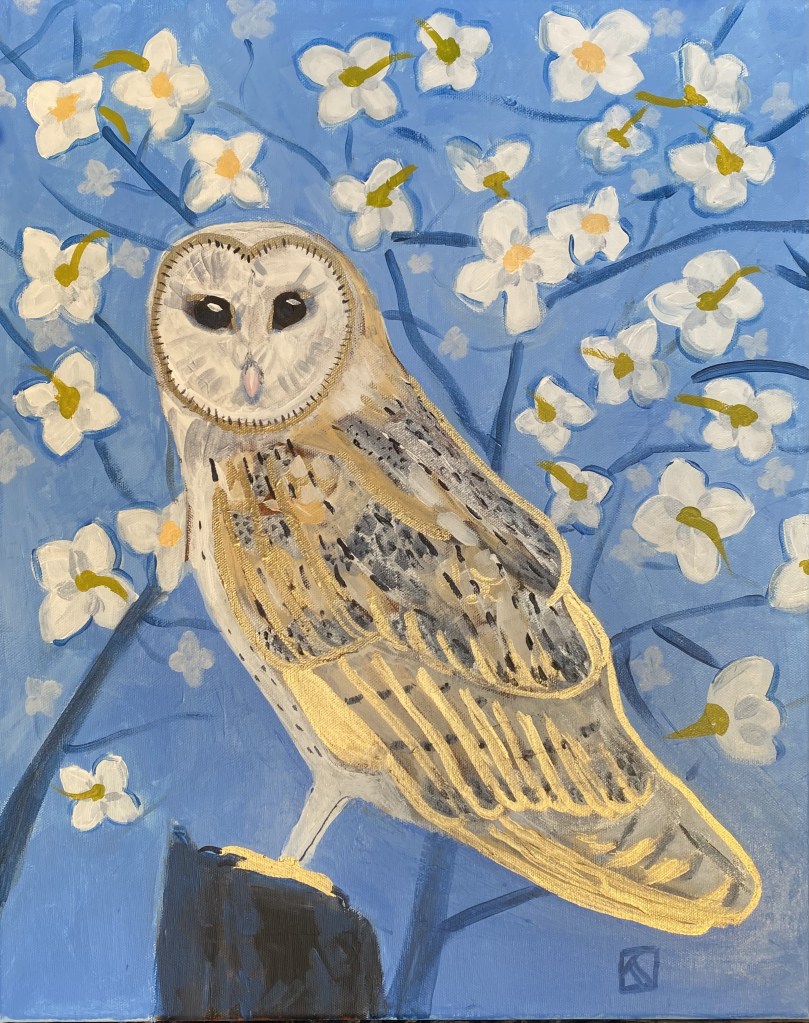
    Barn Owl and Dogwoods on Display at Blackbird Cafe in Tahlequah, Ok.

    A friend once looked at my painting of a barn owl and told me she was a little afraid of it.

    I understood why.

    In Cherokee tradition, owls can carry complicated meanings. Some Cherokee traditions associate owls, particularly the great horned owl, with the spirit world, witches and things that move through the darkness. Owl calls could be regarded as warnings or omens, and the screech owl could serve as a messenger of things yet to come. These traditions are not as simple as saying that every owl is a symbol of death, but there is certainly a reason an owl can make some Cherokee people uneasy.

    So when my friend looked at my painting and felt that uneasiness, I didn’t tell her she was wrong.

    I told her, “It’s not an owl.”

    She looked at me.

    “It’s a painting.”

    I was thinking of René Magritte.

    In 1929, Magritte painted a remarkably realistic pipe and wrote beneath it, Ceci n’est pas une pipe—”This is not a pipe.” Of course it isn’t. You can’t fill the painted pipe with tobacco. It is an image of a pipe, not the thing itself. Magritte was playing with the distance between an object and the image we make of it.

    This is not an owl.

    It is paint on a surface. It is shapes and shadows and light. It is my attempt to capture something I find beautiful: the stillness of a barn owl, its enormous eyes, the softness of its feathers, the strange elegance of a bird made for the night.

    We give things meaning. We inherit meanings from our families and our communities. We learn which animals to welcome, which ones to fear, which ones carry warnings and which ones bring comfort. Those meanings can be powerful. They can even become part of the way we see.

    But a painting is not the thing it represents.

    A painting of an owl cannot fly into your house. It cannot call from your roof. It cannot carry a message from the spirit world. It cannot foretell a death.

    I don’t want to erase the older meanings of the owl. I am Cherokee, and those traditions are part of the complicated landscape of meaning I carry with me. But I also don’t believe an inherited meaning has to be the only way we encounter something.

    Not every owl brings bad news, and this one brings none. Because this is not an owl. It is a painting.

    I hope you see beauty in it.
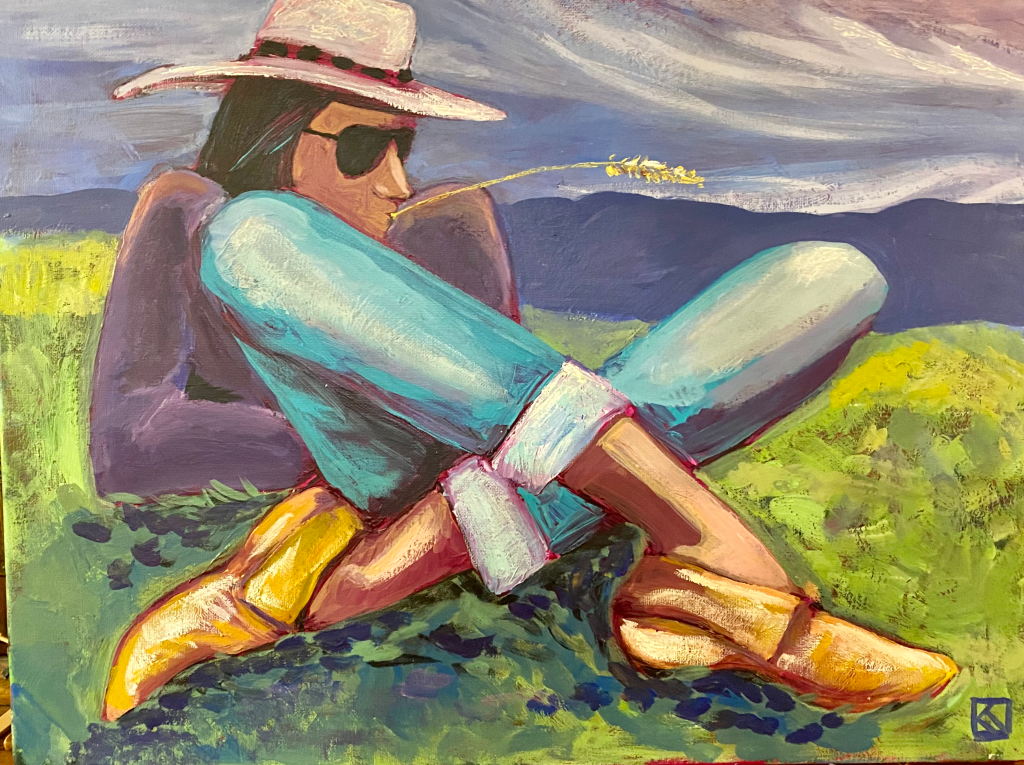
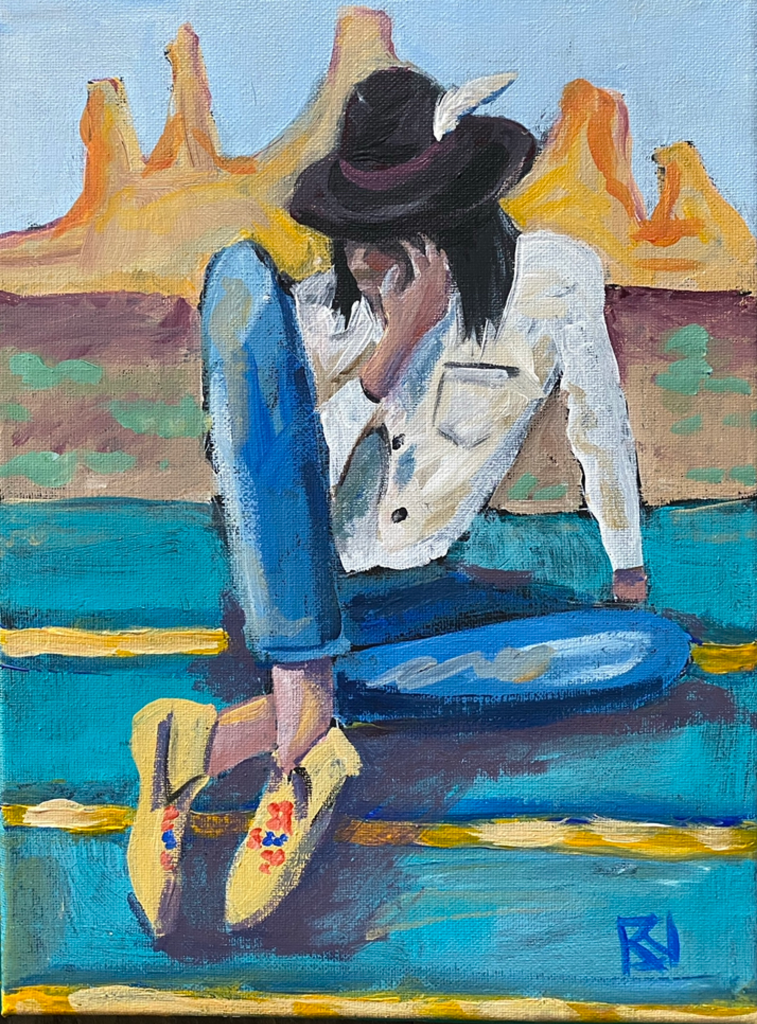
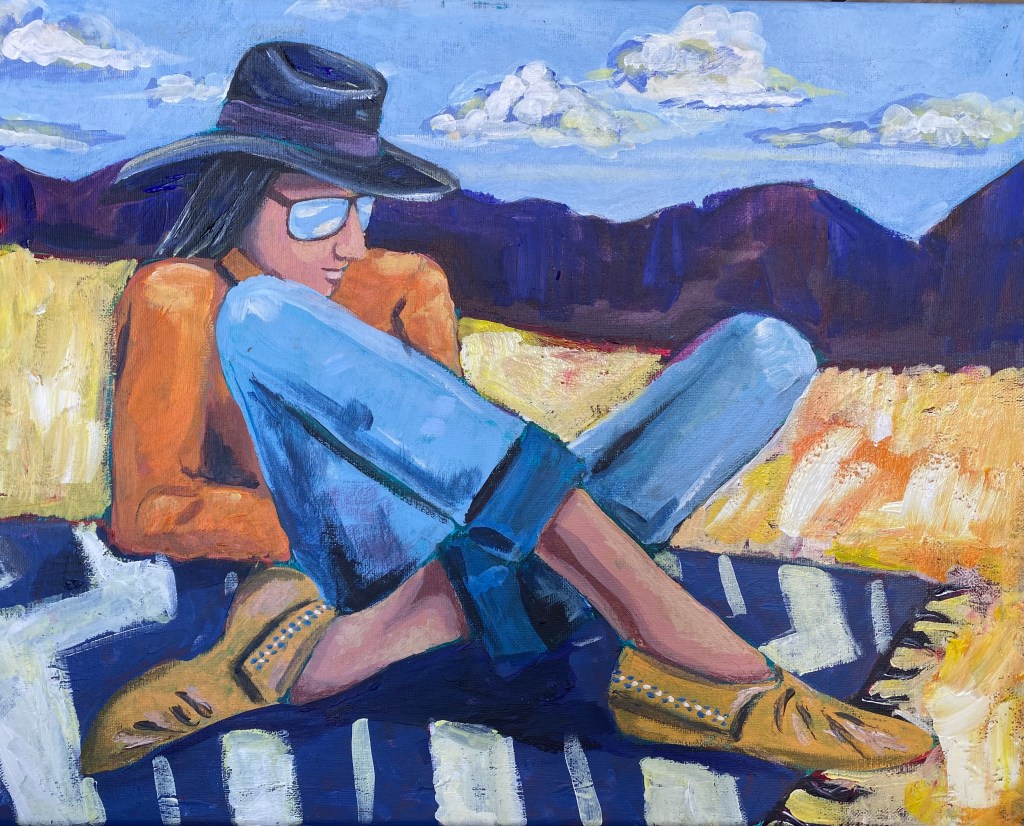
  • Who Wears It Better?

    Somebody’s Uncle, Private collection
    Somebody’s Uncle #2, Private collection
    Somebody’s Uncle #3, Private collection

    Every Cherokee family has one.

    He’s single. Good-looking. Maybe a little bit of a black sheep. He has his own way of doing things and doesn’t seem particularly concerned about what anyone thinks of him.

    Or maybe you see him at a Native gathering. He’s the guy who stands out. Maybe it’s his hat. Maybe it’s the way he’s dressed. Maybe it’s something he’s done that everyone will be talking about before the day is over.

    That’s Somebody’s Uncle.

    I’ve painted several of these men over the years in a series I’ve come to call Somebody’s Uncle. They aren’t portraits of particular people. They don’t even have individual names. They are more like an archetype—a familiar character you might recognize immediately if you’ve spent any time around a Cherokee family or a Native community.

    But the idea comes from my own Uncle Keener Vann.

    Uncle Keener always smelled a little like beer. He liked to fish. He was something of a loner among the family, but we knew that when he got together with his friends, things could take a wild turn.

    When I was a child, my sister, my girl cousins and I would sit out in my grandmother’s driveway with him. We’d listen to him shoot the breeze, telling stories and carrying on. Every so often, he’d look at one of us and ask, with complete affection and a twinkle in his eye, “Are you my girlfriend?”

    We knew exactly what he meant. We loved him.

    The men in my Somebody’s Uncle paintings don’t look like Keener. They aren’t meant to. They have a fairly generic appearance, although there is no mistaking that they are Native men.

    Usually, they’re kicked back on the grass or sitting on a blanket, legs crossed, looking completely unbothered by the world around them.

    They’re not doing much, and that’s the point. They’re simply being.

    There’s something I love about that particular kind of Native masculinity—the ability to sit back, watch the world go by, visit with friends, and appreciate the moment without feeling the need to fill every second with activity.

    These men look like they have nowhere else to be. Maybe they don’t.

    So here are three of my Somebody’s Uncle paintings.

    Which one wears it better?

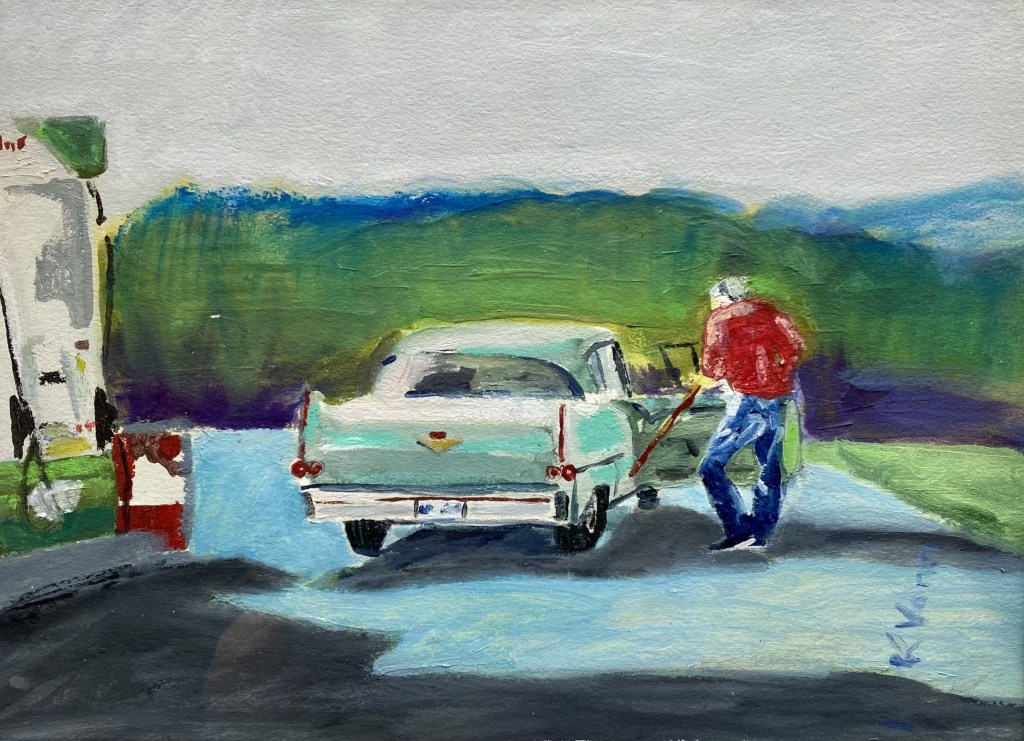
  • Old Man and Cadillac, mixed media on art paper. Available at River & Word Arts Collective in Tahlequah, OK. Prints available.

    There are photographs I take because something catches my eye. And then there are photographs I take because, in that moment, I already know I am going to paint them.

    I’ve experienced that feeling countless times. I can’t always explain what makes one moment different from another. Maybe that is what people mean when they talk about the eye of an artist. It isn’t necessarily about seeing something beautiful. Sometimes it’s about seeing a moment that feels complete—a little story unfolding in front of you—and knowing you want to hold onto it.

    Two paintings come to mind when I think about that instinct.

    The first began at a gas station in Collinsville, Oklahoma.

    An old man with a cane was getting ready to climb into the passenger side of a Cadillac that looked as though it had driven straight out of the 1950s. The driver had just finished pumping gas. There was something about the whole scene—the old car, the old man, the cane, the anticipation of the ride—that made me reach for my camera.

    I took the photograph home and began painting.

    But I wasn’t interested in reproducing the gas station or the city street exactly as I had seen them. I wanted to paint the scene I had imagined when I took the photograph. So I changed the background, turning the Collinsville setting into a more abstract landscape. I used oil pastel to recreate the feeling of the moment with less noise and fewer distractions, putting the focus where I thought it belonged: on the old man with his cane, getting ready to ride shotgun in that beautiful old Cadillac.

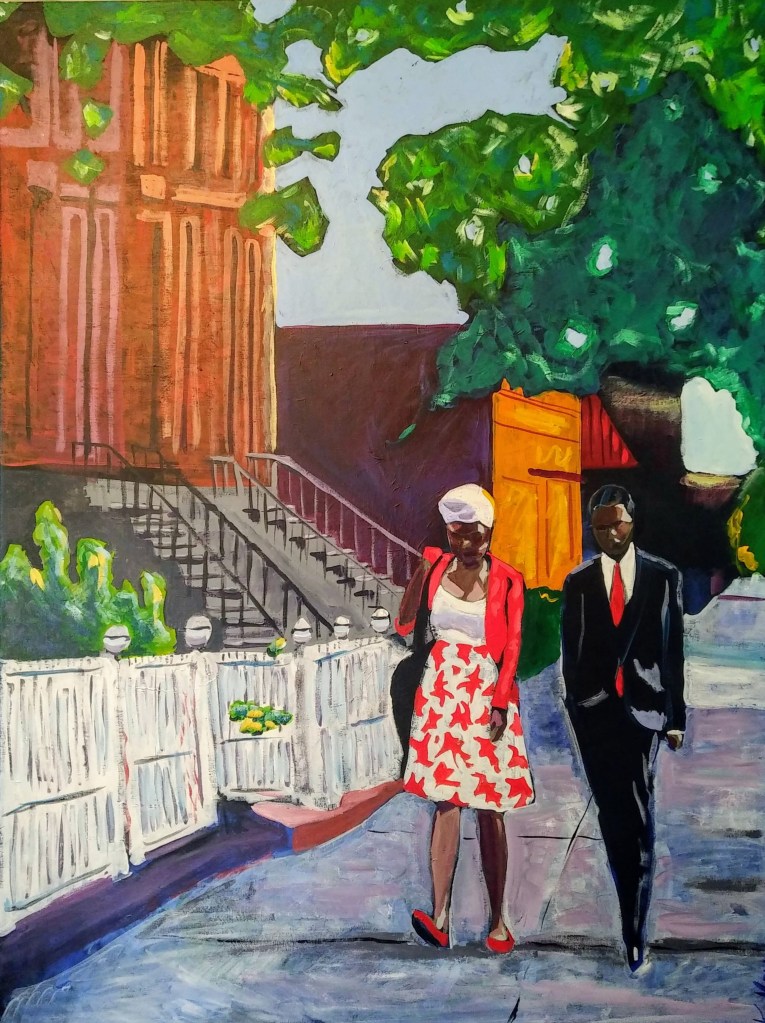
    Brooklyn Brownstones. Acrylic on canvas. Private collection. Prints available.

    The second painting began with a photograph I took in Brooklyn, New York, when my daughter lived there.

    We walked everywhere, and I especially loved the old neighborhoods, with their streets lined with brownstones. One day, an African American couple was walking toward us. They were dressed up, and they looked striking together. He wore a business suit with a red tie. She wore a pretty red-and-white dress and a wrap around her head.

    I took their photograph. Again, I knew.

    When I painted them, I didn’t try to make the painting look like a photograph. Instead, I painted loose and fast, letting the brushwork stay visible and allowing the figures to emerge from the painting rather than carefully constructing every detail.

    The result was exactly what I had imagined it could be when I first saw them walking toward me.

    I listed the painting on Etsy, and several months later it sold to someone in Michigan. I still have the painting of the old man and his Cadillac. I don’t know why it hasn’t found its home yet. Maybe it is simply waiting for the right person.

    I regularly sell prints of both paintings, which tells me that perhaps other people see something in those moments, too.

    I’ve thought about what makes me stop and take a photograph that I know will become a painting. I can’t come up with a formula. It isn’t always beauty. It isn’t always an unusual subject. It isn’t even necessarily a particularly important moment.

    Sometimes it’s the way a person stands. Sometimes it’s the colors. Sometimes it’s a story I can imagine without knowing anything about the people in it. Sometimes it’s just a feeling.

    Some moments just have to be painted. I can’t explain what the criteria is.

    When you know, you know.

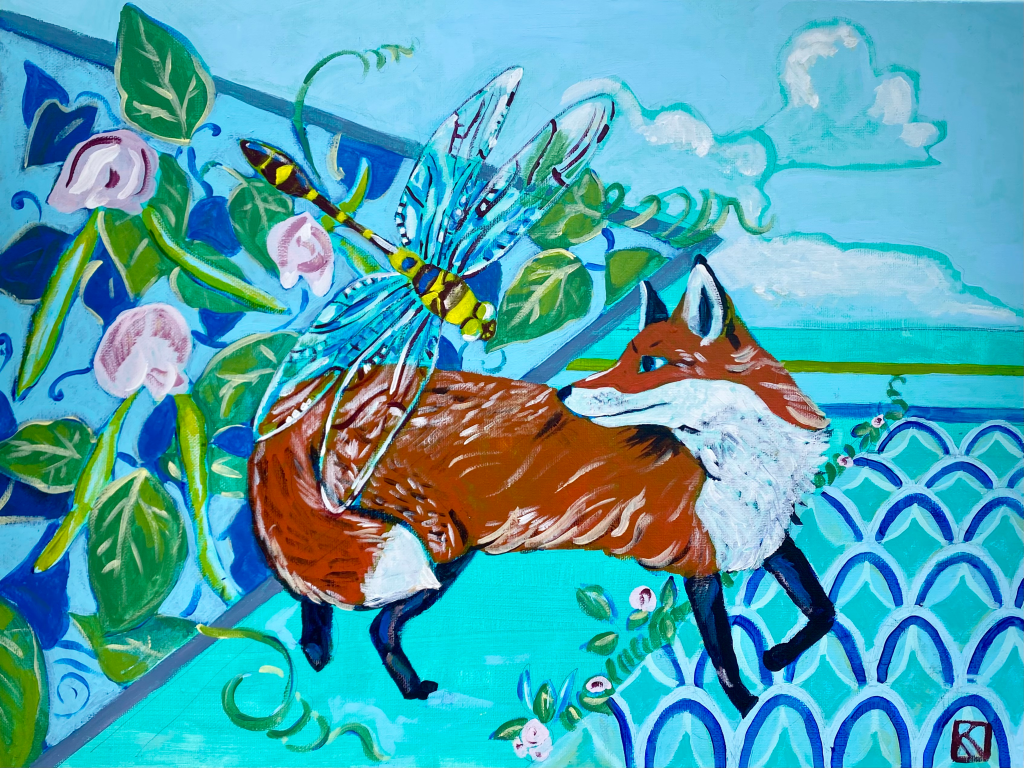
  • Peavine Fox. Acrylic on canvas. Private collection. Prints available.

    Photography changed art. Photography became art.

    When photography came along, the world no longer required portrait artists to record likenesses. It no longer required landscape artists to depict breathtaking mountain scenes for people who could not visit them themselves.

    Photography challenged artists to create beauty that could not simply be found in nature.

    If a photograph can capture it, why should I paint it?

    Because a photograph cannot capture what is created by my mind.

    A camera can capture what has been created by the Creator, but only I can arrange colors and subjects into something meaningful to me.

    Peavine Fox is how I imagined the world of a fox as he discovered nature during his trot among the watercress and other plants along Peavine Creek, which spills into the Illinois River near Hanging Rock on Highway 10.

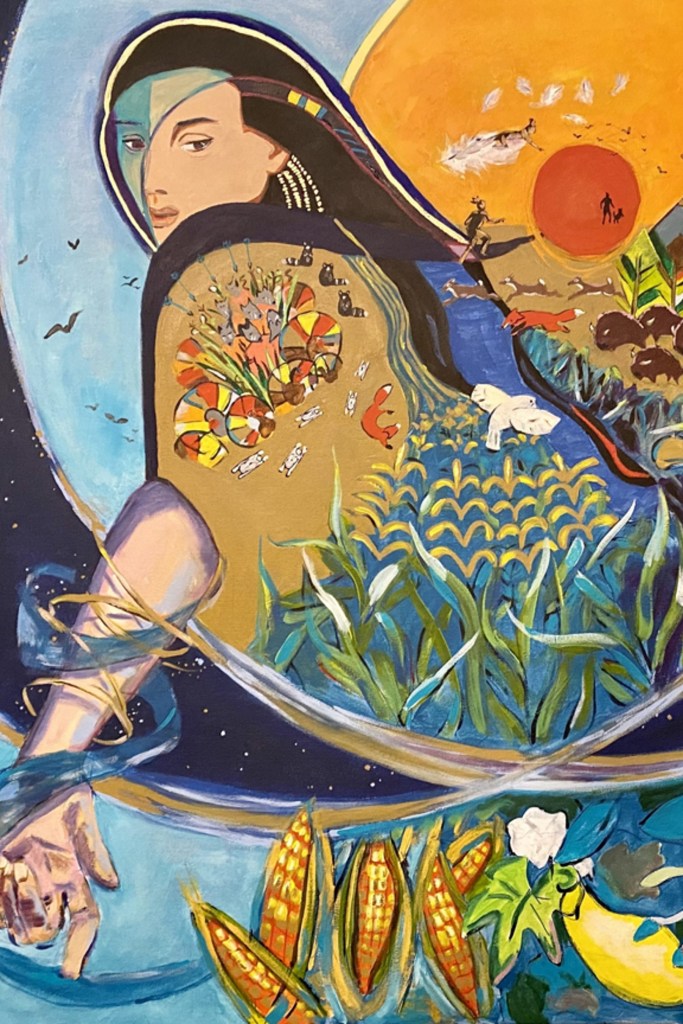
  • Selu and Kenati, acrylic on canvas. Private collection. Prints available.

    In 2022, I painted what I believed might be the best painting I had ever created.

    The subject came from one of our traditional Cherokee stories—Selu and Kanati. I had poured myself into it. When I finished, I entered it in a Cherokee art competition.

    It was juried out.

    That surprised me. My work had always been accepted before, including a realism piece. So, because I was genuinely shocked, I asked why.

    The explanation I received was that, ultimately, the painting subjectively read as “Plains” style and had been juried out for that reason. The coordinator went on to explain that the juror was looking for more traditional Cherokee motifs and symbolism.

    I understood the explanation. I still do. But something about that experience stayed with me.

    The story was Cherokee. The artist was Cherokee. But apparently, the way I chose to tell the story did not look Cherokee enough to someone else.

    I was devastated.

    I haven’t entered a competition since, and I don’t know if I ever will again.

    Not because I believe competitions are wrong. Jurors have their own visions and criteria, and they are entitled to make their choices.

    But that experience made me think differently about my own.

    A few years later, I put the painting in the Red Fern Festival. My cousin, who was managing the artists’ co-op I belonged to at the time, told me he thought it would sell. By then I was still carrying some of the hurt from the competition, and I had underpriced it. He marked it up. It sold that day.

    The woman who bought it was someone I met that day, and she has since become a dear friend. We have stayed in touch.

    I think about that sometimes. A juror looked at the painting and decided it didn’t fit what they were looking for. Another person looked at it and decided she wanted to take it home.

    Neither person was wrong. They were simply looking at the same painting through different eyes.

    And I think that is what I carry forward from the experience. I cannot allow other people’s ideas about what Cherokee art should look like—or what any art should look like—to become a fence around my creativity.

    I am Cherokee. My history, my stories, my experiences, and the things I have inherited all find their way into my work. But I don’t believe they have to arrive in a prescribed visual language.

    I don’t want to paint toward acceptance. I want to paint the things that move me, in the way they ask to be painted.

    That painting taught me something I needed to learn: My creativity does not need permission to be what it is.